As India’s industries and cities expand rapidly, the need for efficient wastewater
management has become more important than ever. A wastewater treatment plant in India
plays a key role in protecting the environment, reducing pollution, and promoting water
reuse.
Bisan Group, headquartered in Pune, is a trusted manufacturer and supplier of wastewater
treatment systems for industrial, commercial, and municipal use. Our plants are
engineered to deliver reliable, sustainable, and cost-effective wastewater management
solutions that help clients comply with CPCB norms and achieve long-term environmental
goals.
What is a Wastewater Treatment Plant?
A wastewater treatment plant (WWTP) is a facility designed to clean and purify used
water—also known as wastewater—before releasing it into nature or reusing it for
industrial and non-potable purposes.
Wastewater contains harmful impurities such as BOD (Biochemical Oxygen Demand), COD
(Chemical Oxygen Demand), TSS (Total Suspended Solids), and TDS (Total Dissolved
Solids). If left untreated, it can cause severe water pollution and health issues.
The wastewater treatment process in India removes these pollutants through physical,
chemical, and biological processes, making the water safe for reuse or disposal.
At Bisan Group, we design customised wastewater treatment systems for both industrial and
domestic applications — ensuring cleaner water, reduced pollution, and CPCB compliance.
Why Wastewater Treatment Is Critical in
India
India’s urbanisation and industrialisation lead to increasing volumes of untreated
wastewater entering rivers and groundwater. According to CPCB and NITI Aayog reports,
only a fraction of generated sewage receives treatment, exacerbating pollution and
health risks. Contaminated water leads to the spread of diseases and ecological damage,
threatening freshwater availability.
The CPCB and State Pollution Control Boards mandate strict wastewater discharge standards
to protect water bodies and public health. Compliance with wastewater regulations and
pollution control measures is obligatory for industries and municipalities to prevent
environmental degradation.
How Does a Wastewater Treatment Plant
Work?
The 4 Stages of Wastewater Treatment
- Preliminary Treatment – Removes large solids, plastics,
and grit through screening.
- Primary Treatment – Allows solid
particles to settle at the bottom via sedimentation.
- Secondary Treatment – Uses aerobic and
anaerobic bacteria to break down organic matter.
- Tertiary Treatment – Final stage with
filtration, disinfection, or ultrafiltration (UF) to ensure water purity.
The 10 Steps of Wastewater Treatment
Process
- Screening
- Grit removal
- Equalization
- Coagulation
- Sedimentation
- Aeration
- Clarification
- Filtration
- Disinfection
- Sludge handling & disposal
Types of Wastewater Treatment Plants in
India
Users often search for “types of wastewater treatment” or “ETP vs STP.” Here’s a simple
breakdown 👇
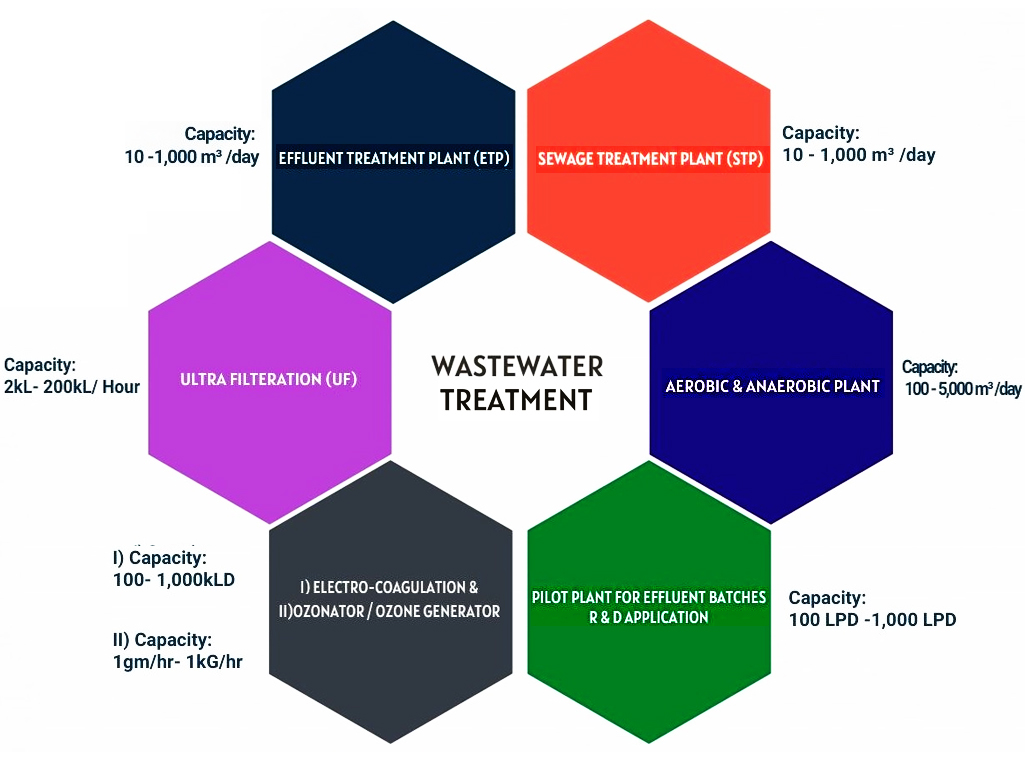
- Effluent Treatment Plant
(ETP)
Designed for industrial wastewater, ETPs treat effluents
containing chemicals, oils, and heavy metals.
Used in: textile, chemical, food,
and pharmaceutical industries.
Capacity: 10–1,000 m³/day.
- Sewage Treatment Plant
(STP)
Treats domestic wastewater from households, hotels, and
commercial complexes.
Reuses treated water for gardening, flushing, or cooling
towers.
- Common Effluent Treatment Plant
(CETP)
Used by industrial clusters to share a central treatment
system — cost-effective for SMEs.
- Zero Liquid Discharge (ZLD)
System
Ensures no discharge into the environment by recycling all
treated water — ideal for water-scarce regions.
- Aerobic & Anaerobic
Plants
Use microorganisms to biologically degrade organic waste.
Suitable for municipal wastewater and large industries.
- Ultrafiltration (UF)
Plants
Used as tertiary treatment or RO pre-filtration, removing
fine particles, bacteria, and viruses.
- Electrocoagulation & Ozone
Systems
Advanced chemical-free technologies ideal for paint,
chemical, and wastewater reuse industries.
- Pilot Plants for
R&D
Compact setups (100–1,000 LPD) for research, testing, and
process validation before full-scale installation.
Applications of Wastewater Treatment
Plants
People also search: “Where are wastewater treatment plants used?”
Bisan Group provides solutions for a wide range of applications:
- Industrial factories: Chemical, textile, sugar,
distillery, and food units.
- Municipalities: City-level sewage
management.
- Commercial buildings: Hospitals,
hotels, malls, and housing societies.
- Water reuse projects: Cooling towers,
irrigation, and landscaping.
Bisan Group designs wastewater treatment systems for every sector — from small-scale
industries to large municipal projects.
Importance of Wastewater Treatment in
India
Key Benefits:
- Prevents water pollution and protects rivers and soil.
- Ensures industries meet CPCB wastewater
guidelines.
- Reduces health risks from contaminated
water.
- Supports water reuse and recycling,
lowering dependency on freshwater.
- Promotes sustainability and
environmental conservation.
With rising water scarcity, wastewater treatment is the backbone of a sustainable India.
Advanced Wastewater Treatment
Technologies by Bisan Group
Bisan Group uses modern and eco-friendly technologies that deliver maximum treatment
efficiency with minimal maintenance:
- Electrocoagulation (X-ECF): Removes heavy metals and
emulsified oils.
- Ultrafiltration (UF): Filters fine
particles and pathogens.
- Reverse Osmosis (RO): Produces
high-purity water for reuse.
- Ozone Generator Systems: Disinfects
water and removes odors.
- Membrane Bioreactor (MBR): Combines
biological and membrane filtration for high efficiency.
- PLC Automation: Enables smart
monitoring and precise control.
Each system is designed for performance, energy efficiency, and sustainability.
Cost and Capacity of Wastewater
Treatment Plants
The cost depends on:
- Plant type (ETP/STP/ZLD)
- Capacity (100 LPD – 5,000 m³/day)
- Treatment technology (UF, RO, MBR,
etc.)
- Site conditions and automation level
Bisan Group offers custom-built, cost-effective, and scalable systems tailored to each
client’s needs — ensuring long-term savings and performance.
Bisan Group – Your Trusted Partner in
Wastewater Solutions
With over a decade of expertise, Bisan Group stands among India’s leading wastewater
treatment plant manufacturers.
Our strengths:
- 10+ years of experience in ETP & STP design and
manufacturing
- ISO 9001:2015 certified
- Pan-India service network
- End-to-end project delivery: Design →
Fabrication → Installation → AMC
- Sustainability-driven engineering
We help industries achieve environmental compliance and efficiency through innovative,
eco-friendly technologies.
Frequently Asked Questions (FAQs)
- Q1. What is the main goal of a wastewater
treatment plant?
To remove pollutants and make wastewater safe for reuse or
discharge.
- Q2. What are the
stages of wastewater treatment?
Preliminary, primary, secondary, and tertiary
treatment stages.
- Q3. What are the two
types of wastewater treatment?
Effluent Treatment Plant (ETP) and Sewage
Treatment Plant (STP).
- Q4. Can we drink water
from a wastewater treatment plant?
No. Treated water is reused for non-drinking
purposes like gardening or industrial cooling.
- Q5. What materials
cannot be removed from wastewater?
Certain dissolved salts or chemicals may
require advanced RO or ion-exchange treatment.
Get a Quote for Wastewater Treatment
Plant in India
Looking for a reliable and cost-effective wastewater treatment plant manufacturer in
India? Contact Bisan Group today for expert consultation and customized ETP, STP, and
ZLD systems that ensure regulatory compliance, efficiency, and sustainability.
📞 Call: +91 86052 53843
Email: info@bisan.in