
Introduction
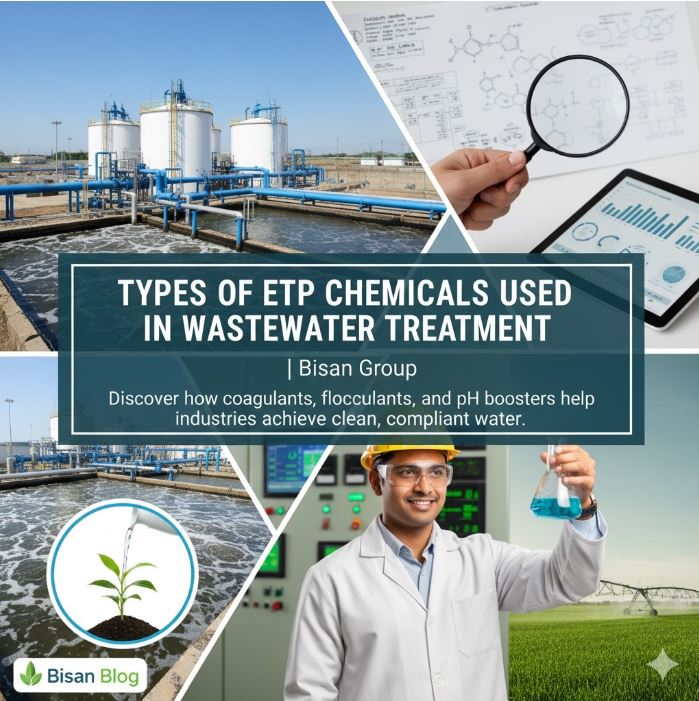
In industries across India, treating wastewater efficiently is not just a necessity—it’s a responsibility. To ensure clean, compliant, and reusable water, Effluent Treatment Plants (ETPs) rely on specialised chemicals that remove pollutants, neutralise contaminants, and maintain the ideal pH balance. These chemicals are the backbone of any industrial wastewater management system.
At Bisan Group, we specialise in manufacturing and supplying high-performance, eco-friendly ETP chemicals that help industries achieve sustainability and regulatory compliance. Let’s explore the types of ETP chemicals used in wastewater treatment and understand how each plays a vital role in purifying industrial effluent.
What Are ETP Chemicals, and Why Are They Essential?
ETP chemicals are substances used in Effluent Treatment Plants to remove harmful contaminants from wastewater before it is discharged or reused. They play a crucial role in separating solids, reducing COD (Chemical Oxygen Demand) and BOD (Biological Oxygen Demand), adjusting pH levels, and disinfecting water.
Using the right combination of chemicals ensures:
- Cleaner and safer discharge water
- Better compliance with CPCB and SPCB norms
- Cost-efficient operation
- Reduced environmental impact
In short, ETP chemicals are essential for keeping industrial wastewater treatment efficient, sustainable, and compliant with environmental regulations.
Classification of ETP Chemicals
ETP chemicals are classified based on the function they perform during the treatment process. Below are the most common categories used across industries.
1. Coagulants – For Solid-Liquid Separation
Function: Coagulants neutralize the charge on suspended solids, allowing them to clump together and settle easily.
Example: GOODTREAT 401 (AMIFLOCK 101) — Bisan Group’s high-performance coagulant designed for efficient clarification.
Applications: Used in the primary stage of wastewater treatment to remove turbidity, organic matter, and suspended solids.
Industries: Textile, food processing, pharmaceuticals, paper, and chemicals.
2. Flocculants – For Improved Sedimentation
Function: After coagulation, flocculants help bind the neutralised particles into larger clumps, or “flocs,” which can easily settle or be filtered out.
Example: GOODTREAT 403 (AMIFLOCK 103) — ensures effective floc formation and faster sedimentation.
Advantages:
- Improves filtration speed
- Reduces sludge volume
- Enhances clarity of treated water
3. COD & Color Removers – For Chemical Decontamination
Function: These chemicals target organic dyes, COD, and color-causing compounds that are often present in effluent from textile and chemical industries.
Example: GOODTREAT 402 (AMIFLOCK 102) — effectively reduces COD levels and eliminates color.
Benefits:
- Ensures clear and odor-free discharge
- Helps meet CPCB discharge standards
- Reduces organic pollutants in effluent
4. pH Boosters and Adjusters – For Neutralization
Function: Maintaining an optimal pH level (typically 6.5–8.5) is vital for efficient treatment. These chemicals adjust acidic or alkaline effluents to the desired range for effective coagulation and biological treatment.
Example: GOODTREAT 404 & 405A (AMIFLOCK 104 & 501) — dual-function pH booster and coagulant.
Application: Used in various industries where effluent pH fluctuates due to chemicals or processes.
5. Polyelectrolytes – For Sludge Dewatering
Function: Polyelectrolytes improve sludge settling and dewatering, helping to reduce the water content in sludge.
Benefits:
- Makes sludge handling easier
- Reduces disposal costs
- Improves dewatering in filter presses
Use Case: Commonly used in the final treatment stage before sludge disposal or reuse.
6. Disinfectants & Biocides – For Final Disinfection
Function: Eliminate bacteria, viruses, and microorganisms from treated wastewater to make it safe for discharge or reuse.
Examples: Benzalkonium Chloride (BKC) and Chlorine Dioxide are widely used disinfectants in industrial treatment.
Application: Used in final polishing stages and reuse water systems.
How These Chemicals Work Together in the ETP Process
The wastewater treatment process is a systematic sequence where each chemical supports a specific function:
- Coagulants neutralize charged particles.
- Flocculants combine particles into larger flocs for easier removal.
- COD/Color Removers eliminate dissolved organic matter.
- pH Boosters stabilize chemical reactions.
- Polyelectrolytes enhance sludge settling.
- Disinfectants ensure microbial safety for reuse or discharge.
Together, these chemicals ensure efficient treatment, clearer water, and compliance with environmental standards.
Applications of ETP Chemicals Across Industries
- Textile & Dyeing Units: For color removal and COD reduction.
- Pharmaceutical Industry: To remove organic contaminants and sterilize effluent.
- Food & Beverage Processing: For odor removal and maintaining pH balance.
- Chemical & Petrochemical Plants: For heavy metal and toxin removal.
- Municipal & STP Plants: For tertiary treatment and disinfection before reuse.
These applications highlight the adaptability and necessity of ETP chemicals in industrial wastewater treatment across India.
Benefits of Using High-Quality ETP Chemicals
- Compliance with CPCB & SPCB norms
- Improved plant efficiency and output
- Reduced sludge volume and handling costs
- Faster filtration and lower chemical consumption
- Long-term cost savings
- Support for Zero Liquid Discharge (ZLD) goals
- Eco-friendly and sustainable operations
Bisan Group ensures every product meets these standards through advanced formulation and rigorous quality control.
How to Choose the Right ETP Chemicals for Your Industry
- Analyze Your Effluent: Understand pH, COD, TSS, and color levels.
- Seek Expert Guidance: Consult professionals for dosage and compatibility.
- Choose Certified Products: Look for ISO 9001:2015 compliance.
- Opt for Eco-Friendly Options: Reduce environmental risks with biodegradable formulations.
- Get Technical Support: Always prefer suppliers who offer MSDS, plant audits, and on-site guidance.
Bisan Group provides tailored chemical recommendations for different industries to ensure optimized performance and compliance.
Why Choose Bisan Group for Effluent Treatment Chemicals
- Comprehensive range: Coagulants, Flocculants, Color Removers, and pH Boosters.
- Proprietary brands: GOODTREAT and AMIFLOCK.
- PAN-India service and delivery network.
- ISO-certified manufacturing process.
- Expert technical support and consultation.
Every product is designed to be eco-friendly, cost-effective, and engineered for performance.
Frequently Asked Questions (FAQs)
- What is the purpose of using chemicals in ETP?
ETP chemicals help remove solids, organic matter, and harmful microorganisms, making water safe for reuse or discharge. - How to identify the right ETP chemical for my effluent type?
The choice depends on effluent composition, pH level, and contaminants. Bisan experts can recommend suitable formulations. - Are ETP chemicals harmful to the environment?
Bisan Group’s products are formulated to be biodegradable and eco-friendly, ensuring safe use and minimal impact. - Can ETP-treated water be reused?
Yes. Properly treated effluent can be reused for gardening, cooling towers, or process water, depending on purity levels. - What is the difference between coagulant and flocculant?
Coagulants neutralize suspended particles, while flocculants bind them into larger clusters for easier removal.
Get Expert Help for ETP Chemicals Selection
Looking for reliable, high-performance ETP chemicals for your industrial wastewater treatment needs? Contact Bisan Group today to get customized solutions designed for maximum efficiency and compliance with environmental standards.
Call: +91 86052 53843
Email: info@bisan.in