
Introduction
Every industry, hospital, and residential complex faces one growing challenge — how to manage wastewater responsibly. From factories producing chemicals to large housing societies, each generates a different kind of wastewater. But not all wastewater can be treated the same way.
That’s where two essential systems come in: STP (Sewage Treatment Plant) and ETP (Effluent Treatment Plant). Both are designed to treat wastewater, but they handle very different types of waste. Choosing the right one is not only crucial for environmental protection but also for legal compliance and sustainability.
In this blog, we’ll explain the difference between STP and ETP, how each system works, and how to decide which one your facility needs.
What Are STP and ETP? (Full Forms and Basic Definitions)
Before understanding the difference, let’s start with their full forms:
- ETP Full Form: Effluent Treatment Plant
- STP Full Form: Sewage Treatment Plant
Both systems treat wastewater but from different sources:
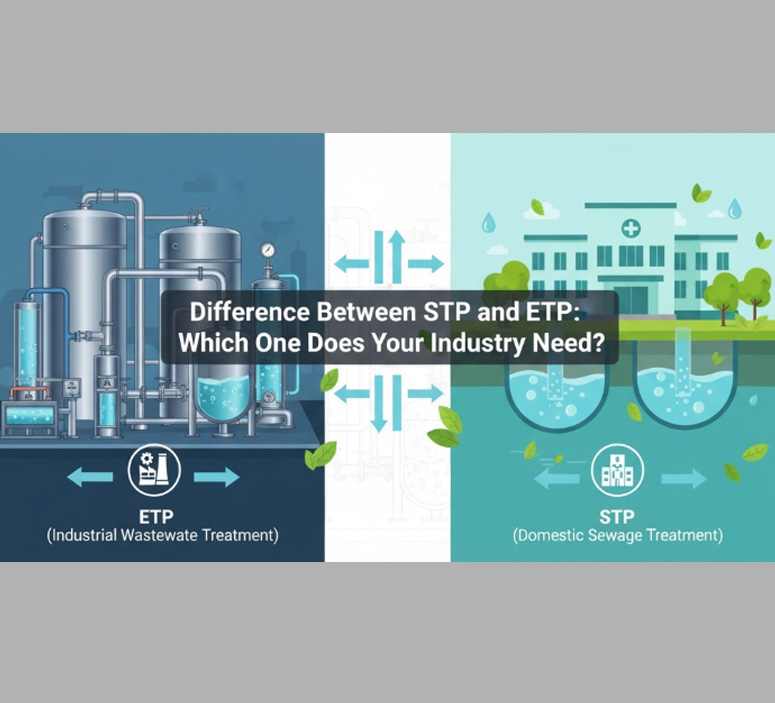
- An ETP is used in industrial setups to clean water that contains chemicals, oils, grease, dyes, or heavy metals.
- An STP is used in residential, commercial, or institutional setups to treat domestic sewage — water from toilets, kitchens, bathrooms, and laundry.
Example:
- ETP → Factories, textile units, pharmaceuticals, plating industries, food processing plants.
- STP → Hospitals, apartments, hotels, schools, and office complexes.
At Bisan Chemicals, we design and manufacture custom ETP and STP systems suitable for every type of industry and water composition.
Purpose and Function of STP and ETP
Purpose of an ETP Plant
- Remove harmful substances like heavy metals, acids, oils, and organic waste.
- Meet Pollution Control Board (PCB) discharge standards.
- Reuse treated water for processes like cooling or cleaning, reducing freshwater demand.
Purpose of an STP Plant
- Remove organic matter, odor, and disease-causing bacteria.
- Produce clean, odor-free water for reuse in flushing, gardening, or cooling.
- Prevent environmental pollution and groundwater contamination.
Key Differences Between STP and ETP
| Criteria | STP (Sewage Treatment Plant) | ETP (Effluent Treatment Plant) |
|---|---|---|
| Type of Water Treated | Domestic sewage | Industrial effluent |
| Common Pollutants | Organic waste, soap, oil, bacteria | Chemicals, heavy metals, dyes |
| Treatment Process | Biological | Physical, chemical, biological |
| Installation Site | Apartments, hospitals, offices | Factories, manufacturing units |
| Treated Water Use | Gardening, flushing, cooling | Reuse in process or discharge |
| Governing Norms | Local municipal or PCB norms | CPCB / SPCB industrial norms |
| Operation Complexity | Moderate | Higher – requires skilled operators |
Process Overview: How STP and ETP Work
Both ETP (Effluent Treatment Plant) and STP (Sewage Treatment Plant) are designed to clean wastewater, but the type of water they treat — and how they treat it — are quite different. Understanding how each system works helps industries, institutions, and builders choose the right plant for their needs.
ETP Process – Industrial Wastewater Treatment
- Primary Treatment – Removing Solids and Oils: Screening, oil & grease removal, sedimentation.
- Secondary Treatment – Biological Breakdown: Aeration tanks, activated sludge, biofilm reactors reduce BOD & COD.
- Tertiary Treatment – Advanced Purification: Filtration, chemical disinfection, RO/UV for high-purity water.
STP Process – Domestic Sewage Treatment
- Preliminary Treatment: Screening and grit removal.
- Primary Sedimentation: Sludge settles, lighter liquid moves to secondary treatment.
- Secondary Treatment: Aeration, activated sludge, MBBR removes organic matter.
- Tertiary Treatment: Filtration, disinfection, storage for reuse in gardening, flushing, or cooling.
Which One Does Your Industry Need?
- Industrial Setup: If your unit generates wastewater from manufacturing processes (with oils, dyes, or chemicals), you need an ETP.
- Commercial or Residential Property: If the wastewater is from toilets, kitchens, or bathrooms, you need an STP.
- Hospitals, Hotels, or Research Centers: Usually require both systems — an STP for sewage and an ETP for laboratory or chemical waste.
Why Regular Maintenance of STP and ETP Is Crucial
- Consistent Performance: Prevents blockages, overflow, and mechanical failures.
- Cost Savings: Regular cleaning avoids expensive breakdowns.
- Legal Compliance: Ensures discharge meets CPCB / SPCB norms at all times.
Environmental and Operational Benefits
- Compliance with CPCB and SPCB discharge norms.
- Reduces pollution and protects water resources.
- Encourages reuse of treated water, lowering water bills.
- Builds your brand’s image as a sustainable, responsible organization.
Conclusion: Making the Right Choice for Your Industry
- STP treats domestic sewage from kitchens and toilets.
- ETP treats industrial effluent with chemicals and heavy metals.
- Choosing the correct system ensures your facility operates responsibly and meets all environmental standards.
If you’re unsure which one fits your setup — Contact Bisan Chemicals for expert guidance and customized wastewater treatment solutions that help you stay compliant, sustainable, and efficient.