
If your drinking water tastes strange, smells like chemicals, or causes irritation, you’re not alone. Across India, households, societies, and industries frequently face water quality issues due to contaminated borewells, ageing pipelines, and microbial buildup.
To make water safe, disinfectants are added � and one of the most effective and safest among them is Chlorine Dioxide (ClO2), widely used by municipalities, hospitals, industries, and water treatment plants.
Unlike chlorine, chlorine dioxide is a selective oxidizer, works at very low doses, does not form harmful by-products, and is far more effective at killing bacteria, viruses, and biofilm. Bisan Group’s C-Dox Chlorine Dioxide Powder (5000 ppm) is one such advanced disinfectant trusted for potable water treatment.
This guide explains how much chlorine dioxide is safe in drinking water, ideal dosing levels, how to calculate dosage, and why C-Dox is preferred over traditional chlorine.
What Is Chlorine Dioxide and Why Is It Added to Drinking Water?
Chlorine dioxide (ClO2) is a powerful and stable disinfectant used to eliminate:
- Bacteria
- Viruses
- Protozoa like Giardia and Cryptosporidium
- Algae and fungi
- Biofilm inside pipelines
Unlike chlorine, it does not react with organic matter to form harmful chlorinated compounds. This makes it significantly safer and more efficient for drinking water treatment.
C-Dox (Bisan Group’s chlorine dioxide powder) is specially formulated to:
- Work at low ppm
- Avoid corrosion
- Remove taste and odor issues
- Kill pathogens rapidly
- Maintain water safety for long distribution pipelines
How Much Chlorine Dioxide Is Safe in Drinking Water? (India & International Standards)
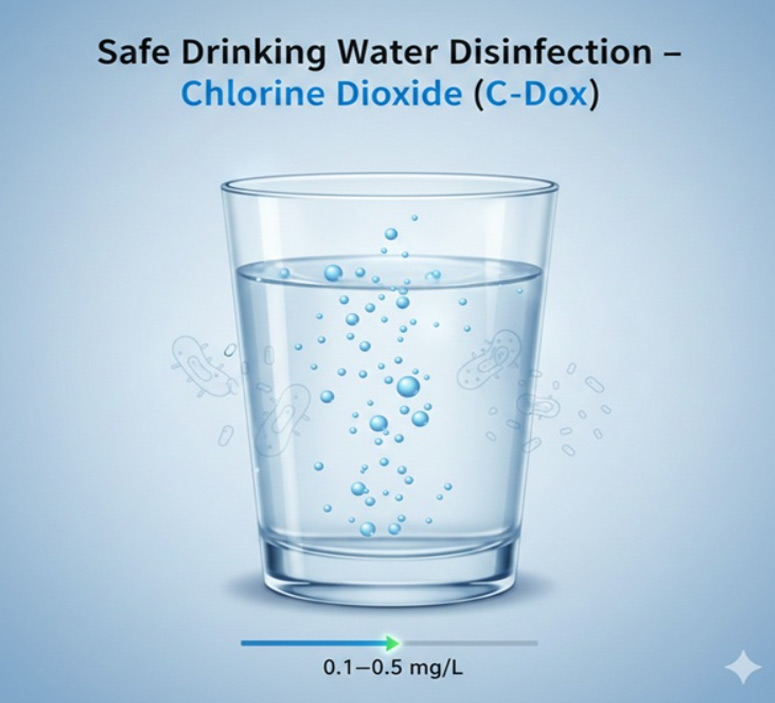
For drinking water disinfection, the safe residual chlorine dioxide level is:
0.1 to 0.5 mg/L (ppm)
This range is safe, effective, and approved for potable water use around the world.
- 0.1�0.3 ppm: Normal water supply
- 0.3�0.5 ppm: High contamination or long distribution pipelines
Chlorine dioxide works so efficiently that you need far lower doses compared to traditional chlorine.
Recommended C-Dox Dosage for Drinking Water
C-Dox comes as a 5000 ppm chlorine dioxide powder, meaning it is highly concentrated.
1. How Much C-Dox Per Litre of Drinking Water?
To achieve 0.3 ppm chlorine dioxide in drinking water:
- You need 0.3 mg of chlorine dioxide per litre
- This requires only a very small quantity of C-Dox powder, because it is 5000 ppm strength
This levels ensures disinfection without affecting taste or safety.
2. How Much C-Dox for 1,000 Liters of Drinking Water?
Formula:
Dose (mg) = Volume (L) � Target Concentration (mg/L)
For 0.3 mg/L target:
1000 L � 0.3 mg/L = 300 mg chlorine dioxide
Since C-Dox is highly concentrated, only a small amount of the powder is required to generate this dose.
3. How Much C-Dox for 5,000 Litres of Drinking Water?
5000 L � 0.3 mg/L = 1500 mg chlorine dioxide
Again, the actual amount of C-Dox powder needed is minimal because the powder releases chlorine dioxide gradually when dissolved.
Chlorine Dioxide vs Chlorine � Why C-Dox Is Safer
Chlorine dioxide is not the same as chlorine.
Feature |
Chlorine |
Chlorine Dioxide (C-Dox) |
By-products |
Forms harmful chlorinated compounds |
No harmful by-products |
Required dose |
High mg/L |
Very low ppm |
Reacts with ammonia? |
Yes |
No |
Removes biofilm |
Weak |
Very strong |
Odor/taste |
Strong smell |
No unpleasant after-taste |
Safe for drinking water |
Limited |
Highly preferred |
This makes chlorine dioxide a smarter and safer choice for homes, societies, commercial buildings, industries, and municipal corporations.
Side Effects of Excess Chlorine Dioxide
When kept within 0.1�0.5 mg/L, chlorine dioxide is safe.
However, high overdose may cause:
- Slight chemical smell
- Temporary throat irritation
- Water taste changes
These issues occur only when dosing exceeds recommended limits.
At correct levels, chlorine dioxide is one of the safest disinfectants for drinking water.
How to Calculate C-Dox Dosage Correctly (Simple Formula)
Use this formula:
Required ClO2 (mg) = Tank Volume (L) � Desired Concentration (mg/L)
Examples:
- For 500 L at 0.3 mg/L ? 500 � 0.3 = 150 mg
- For 1,000 L at 0.3 mg/L ? 300 mg
- For 5,000 L at 0.3 mg/L ? 1500 mg
This is the correct way to calculate chlorine dioxide dosage � not the chlorine mg-per-litre method used earlier.
Why Industries Prefer C-Dox for Water Disinfection
C-Dox is widely used because it offers:
- Rapid pathogen kill
- No taste/odor issues
- No carcinogenic by-products
- Works across pH 4�10
- No corrosion at use concentrations
- Effective against biofilm, algae, fungi, spores
Industries like food processing, pharma, beverages, hotels, water plants, and municipalities rely on chlorine dioxide for safe, stable, long-distance water supply.
Conclusion: Maintain Safe Chlorine Dioxide Levels for Clean Drinking Water
Safe drinking water requires disinfection that is effective, eco-friendly, and residue-free. Chlorine dioxide meets these standards better than traditional chlorine. Maintaining 0.1�0.5 mg/L chlorine dioxide ensures water that is clean, safe, and free from harmful microorganisms.
If you are looking for a reliable and safe drinking water disinfectant, Bisan Group’s C-Dox Chlorine Dioxide Powder (5000 ppm) is one of the most trusted solutions in India.
A safer, cleaner water supply begins with the right disinfectant � and chlorine dioxide is the modern choice for both households and industries.
FAQs
1. What is the safe chlorine dioxide level in drinking water?
The safe level is 0.1�0.5 mg/L (ppm), which effectively disinfects water without affecting taste or safety.
2. How much C-Dox do I need for 1,000 litres of drinking water?
To achieve 0.3 mg/L chlorine dioxide, you need 300 mg of chlorine dioxide generated from C-Dox powder.
3. Is chlorine dioxide safe for daily drinking?
Yes. At recommended levels, chlorine dioxide is approved internationally for daily drinking water use.
4. Does chlorine dioxide remove biofilm in pipelines?
Yes. Chlorine dioxide is highly effective in dissolving and preventing biofilm, unlike chlorine.
5. Is chlorine dioxide better than chlorine?
Yes. It works at lower doses, leaves no harmful by-products, removes odors, and has higher microbial kill efficiency.
6. Can chlorine dioxide be used in housing societies and industries?
Absolutely. C-Dox is used in apartments, hospitals, industries, STPs, ETPs, cooling towers, and municipal water systems.